
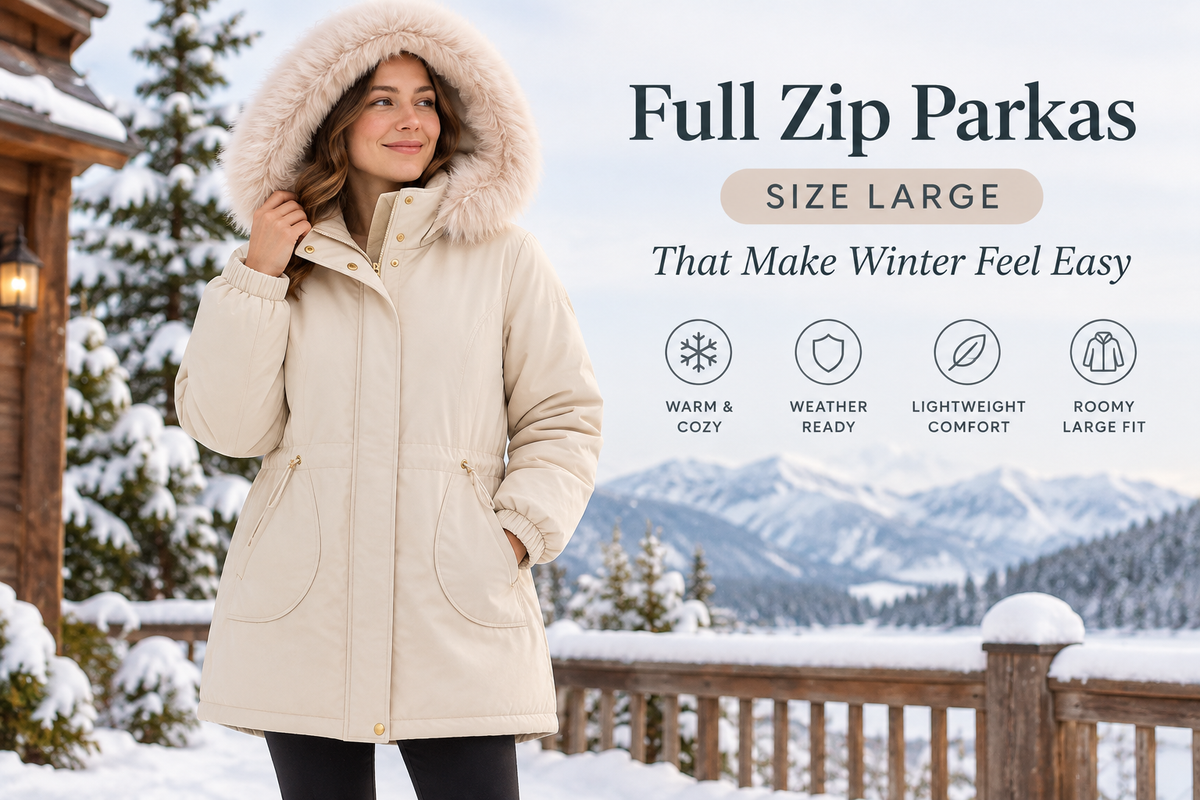
How to Choose Full Zip Parkas Size Large That Fit Comfortably Over Winter Layers
The best full zip parkas size large fit comfortably over your thickest regular winter layer without pulling across the chest, restricting your arms, or riding up at the hem. Because "large" varies from brand to brand, measurements matter more than the label.
Check chest, shoulder, sleeve, and hip measurements against the brand’s size chart
Measure yourself while wearing the sweater or midlayer you plan to wear under the parka, then compare those numbers to the brand’s size chart. Measuring over clothing gives a more realistic picture than measuring over a thin tee.
- Chest: Measure around the fullest part of your bust. Check that the chart's chest measurement leaves 2–4 inches of ease for layering.
- Shoulders: Measure straight across your upper back from shoulder point to shoulder point. Seams should sit at or just past your shoulder bone.
- Sleeves: Measure from the center back of your neck, over your shoulder, to your wrist. Bend your elbow to confirm the cuff won't slide above your wrist bone.
- Hips: Measure around the widest part of your hips. A parka that reaches mid-thigh needs enough room to zip closed while you sit or walk.
If your measurements fall between sizes, check whether the chart lists garment measurements (the actual coat) or body measurements. Garment measurements show how much built-in room a parka has, which is the more useful figure for layering.
Choose a regular or relaxed fit based on layering needs and preferred mobility
Choose a regular fit if you mostly wear light to medium layers, and a relaxed fit if you wear chunky knits or want extra freedom of movement. Both can work in a size large, but they feel different once zipped.
| Fit | Best for | Layering room |
|---|---|---|
| Regular | Commuting, polished looks | Tee plus light sweater |
| Relaxed | Cold climates, active days | Thick knit or fleece |
Test mobility by reaching forward as if you're driving or carrying a bag. If the back feels tight or the sleeves lift noticeably, the fit is too snug for winter layers. Insulation also adds bulk, so a puffy parka may feel smaller than a lightweight shell in the same size.
If a parka zips easily over your chosen layers and still lets you cross your arms comfortably, you've found the right size large.
Compare Insulation and Weather Protection for Your Winter Conditions
Once the fit is right, the next decision is what keeps you warm and dry. Insulation type and shell construction matter more than the label "parka," and the best choice depends on whether your winter is dry and frigid or damp and unpredictable.
Weigh down warmth against synthetic insulation’s better performance in damp weather
Down offers the most warmth for its weight, but synthetic insulation keeps working when wet. Down feathers clump when damp and lose much of their loft, while synthetic fill retains insulating air pockets and dries faster. If your winter means snow that melts, drizzle, or humid cold, synthetic is the safer pick.
- Down: Best for dry, deep cold; lightweight and highly compressible. Check fill power (600 to 800+ means better warmth for its weight).
- Synthetic: Best for wet, changeable weather; usually more affordable and easier to wash.
- Blends: Some parkas place synthetic fill in areas that get wet, such as the shoulders and hood, and use down elsewhere.
A size large parka with heavy fill can feel bulkier than expected, so factor in the loft when checking that you still have room for a sweater underneath.
Compare water-resistant shells, waterproof construction, wind protection, and coverage
A water-resistant shell handles light snow and brief showers, while a waterproof shell with sealed seams is needed for sustained rain or wet snow. Water-resistant fabrics are usually treated with a durable water repellent (DWR) finish that wears off over time, so they suit short commutes better than long days outside.
| Shell Type | Best For | Limitation |
|---|---|---|
| Water-resistant | Light snow, short walks | Soaks through in steady rain |
| Waterproof | Rain, wet snow, long exposure | Less breathable |
| Windproof lining | Exposed, gusty areas | Can feel stiffer |
Wind protection is just as important as insulation, since wind strips away warmth quickly. Look for a tightly woven outer fabric, a storm flap over the zipper, and a hood that stays put. Coverage matters too: a longer hem shields your hips and thighs, which makes a real difference when you are standing at a bus stop or walking in open areas.
Which Full-Zip Features Make a Size Large Parka Easier to Wear?
The features that matter most are a smooth two-way zipper, a storm flap, an adjustable hood, secure cuffs, and a cinchable hem. Once you've matched insulation and weather protection to your climate, these details decide whether a parka feels effortless or frustrating every morning.
Assess zippers, storm flaps, hoods, cuffs, and adjustable hems for everyday convenience
Start with the zipper, since a full-zip parka is only as easy as its closure. Look for a sturdy, snag-resistant zipper with a large pull tab you can grab with gloves on. A two-way zipper lets you open the hem for sitting or driving without unfastening the chest. Pair it with a storm flap secured by snaps or hook-and-loop tape to block wind along the zipper line.
Then check the details that shape comfort and warmth:
- Hood: Choose a detachable or adjustable style with a drawcord, and make sure it can fit over a beanie without blocking your side vision.
- Cuffs: Elastic, knit, or hook-and-loop cuffs seal out drafts and stay put when you reach for bags or door handles.
- Hem: A drawcord or toggle hem traps heat in wind, and releasing it keeps a size large parka from feeling boxy indoors.
Compare pocket placement, weight, length, and packability for commuting or outdoor use
Pocket placement should match what you carry. Zippered hand pockets set slightly above the hip keep keys and cards secure, while an interior pocket protects your phone from cold-drained batteries. If you wear a crossbody bag, check that the pockets remain reachable beneath the strap.
Weight and length work together. A lighter parka is easier to wear all day, but a longer cut offers more coverage for waiting at bus stops or walking in wind. Use this quick guide:
| Use | Best length | Priority |
|---|---|---|
| Daily commute | Hip to mid-thigh | Easy movement |
| Cold-weather walking | Mid-thigh to knee | Extra coverage |
| Travel | Hip to mid-thigh | Packability |
Packability matters if you move between heated spaces and the outdoors. Parkas with compressible synthetic fill fold down more easily, while heavier styles are better kept for sustained, severe cold. Before buying, picture how you will carry the parka once you take it off, because that often determines how often you'll wear it.
How to Compare Parka Styles, Materials, and Value Before Buying
Match parka length and design to your routine, climate, and wardrobe
The best parka length is the one that suits how you move through your day. Hip-length styles work well for driving, desk jobs, and frequent stairs. Mid-thigh and knee-length styles give more warmth for long walks, bus stops, and windy commutes. Because a full zip parka in size large often has extra room for layering, the length also affects how the coat hangs over jeans, leggings, or dresses.
- Hip-length: easy to sit in and pairs well with denim and boots.
- Mid-thigh: a balanced choice for most cold-weather routines.
- Knee-length: best for severe wind chill, but bulkier when sitting or driving.
Check the design against what you already own. Neutral shades such as black, olive, camel, and navy go with the most outfits. A faux-fur hood trim or a cinched waist adds shape, though a simple, streamlined silhouette is easier to wear with chunky scarves and bulky sweaters.
Evaluate durability, care requirements, return policies, and cost per season
A durable parka has tight stitching, reinforced seams, a sturdy zipper, and a shell fabric that resists snagging. Look at the cuffs, pocket edges, and hood attachment, since these areas wear out first. Check the care label before buying, because some parkas can be machine washed while others need dry cleaning, which adds to the ongoing cost.
Check the return policy as well. Outerwear is hard to judge from photos, so a clear return window lets you test the fit over your usual sweaters at home. Keep the tags attached until you are sure.
Cost per season is the purchase price divided by the number of winters you expect to wear the coat.
For example, a $150 parka worn for five winters costs $30 per season. A $90 coat that loses its insulation or zipper after two winters costs $45 per season. A slightly higher price for better materials and construction is often the better value over time.
Full Zip Parkas Size Large: FAQs and a Practical Fit Checklist
A size large parka should zip fully over a sweater without pulling across the chest or back, and it should still leave room for your arms to move. Try it on with the thickest midlayer you plan to wear. Then hug yourself, reach forward, and raise your arms. If the hem lifts well above your hips or the sleeves ride up past your wrists, the cut is too snug for layering.
The shoulder seams should sit at the edge of your shoulders, not drooping down your arms. Sleeves should cover your wrist bones and leave space for gloves.
Not automatically. Check the brand's chest measurement first, because a relaxed-fit large often fits chunky knits and fleece already. Size up only if the large feels tight over a sweater or the zipper strains at the bust or hips.
Going too big has drawbacks: extra space lets warm air escape, and loose sleeves can bunch under gloves. If you sit between sizes, choose the larger one for heavy layering and a regular fit for lighter midlayers. Adjustable hems and cuffs help close gaps.
Synthetic insulation is usually the better choice for damp, cold conditions because it keeps much of its warmth when wet and dries faster than untreated down. Pair it with a water-resistant or waterproof shell, taped seams, and a storm flap over the zipper.
Down offers excellent warmth for its weight and suits dry, very cold days. Water-repellent treated down can work in light snow, but it still needs more care in steady rain.
Follow the care label first, then wash on a gentle cycle with a mild detergent made for outerwear. Close all zippers and fasteners, and skip fabric softener because it can coat fibers and reduce loft. Run an extra rinse to remove soap residue.
Dry on low heat with a few clean tennis balls or dryer balls to break up clumps, and make sure the parka is fully dry before storing it. For storage, use these steps:
- Hang it on a wide, sturdy hanger or store it loosely in a breathable bag.
- Avoid long-term compression in a tight stuff sack.
- Keep it in a cool, dry closet away from direct sunlight.
- Zip it over your thickest planned layer without strain.
- Confirm the shoulders, sleeves, and hem sit correctly.
- Check the insulation type against your local weather.
- Review the return policy in case the fit needs adjusting.



Share:
Distressed Hooded Cloak Styling: Wear It Like a Pro